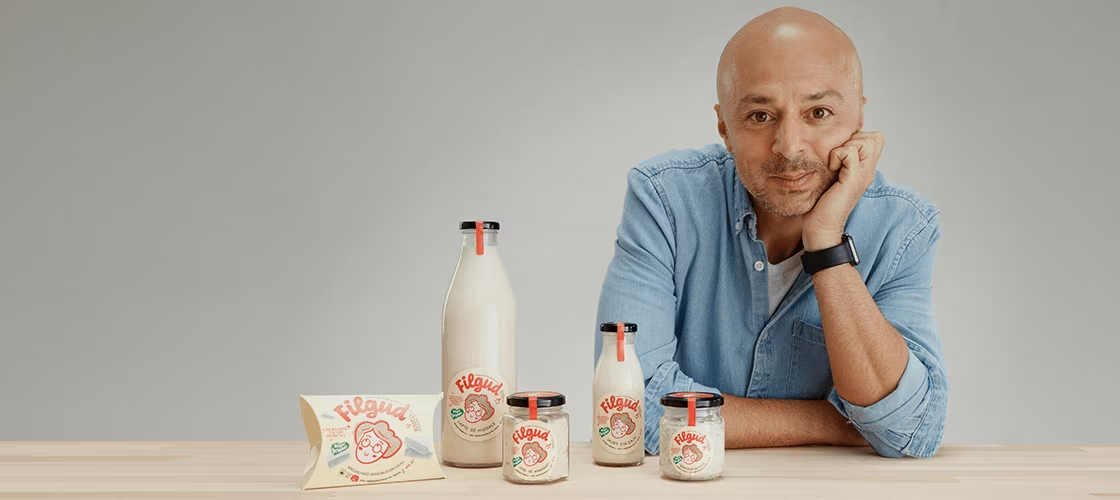
Andrei Roșu seems to have done it all: he worked in a corporate environment, ran marathons and ultramarathons on 7 continents, entered the Guinness World Records, learned to overcome his fears, and started a successful vegan business. The turning point came when his first child was born, which opened his eyes and made him want to be a true role model.
We spoke with Andrei, curious to hear his story. Let’s see what it’s like to be many facets of the same person, as he put it himself. Endurance athlete, social entrepreneur, musician, blogger, writer, father. Not necessarily in that order: “I have many roles. They are different facets of the same person. I believe you shouldn’t limit your personality and should let your passions run free,” Andrei confessed.
The road to endurance
The “turning point,” the road to the North Pole, and the desire to be a role model for his child
“The turning point is when you’ve had enough. Many of us have a nearly full cup, but we’re missing that moment that makes us say ‘that’s it, no more.’ The moment you become a parent, you automatically become a role model for your child, and that’s when you think about what kind of role model you want to be. I quit smoking. I made some small adjustments to my life when my child was born. I chose to run a marathon at the North Pole. I figured that would be a goal that would help me make changes in my life.”.
The North Pole had been a fascination for Andrei since he was a child, ever since he read Jules Verne. He always found it interesting, and the desire to get there was greater than the desire to actually run the marathon. His 16 years of corporate work helped him in setting priorities and goals. Discipline is essential, and he had training from his job, so it was easy for him to transfer that to the sports arena.

Andrei Roșu, the first person to run marathons and ultramarathons on all 7 continents
In March 2012, Romanian newspapers wrote about Andrei Roșu, who ran 7 marathons and 7 ultramarathons on 7 continents. He managed to complete the 14 races in 582 days, compared to the 730 required by the Guinness World Records.
“That was the moment I decided I had to change the course of my life. It was clear I wanted to transform myself. Once you transform, you don’t want to go back to the old version.”, Andrei told us.
But it’s not as simple as it sounds. It takes dedication, time, ambition, and the right motivation. To reach the world record, Andrei had a plan and stuck to it. He trained intensely 4 times a week, and after he succeeded, he was able to ask himself: “How hard can anything else in life be?”
“The idea of an ultramarathon wasn’t planned. A few months after I ran my first marathon at the North Pole, I was in Antarctica for the marathon there. And the day after the Antarctica marathon, there was a 100 km ultramarathon. I wasn’t trained for it; I hadn’t prepared for ultramarathons. I said, 100 km means 4 laps of 25 km. I’ve run 25 km before, so how hard can it be? Plus, I had found out I was going to be a father for the second time.”, Andrei recounted.
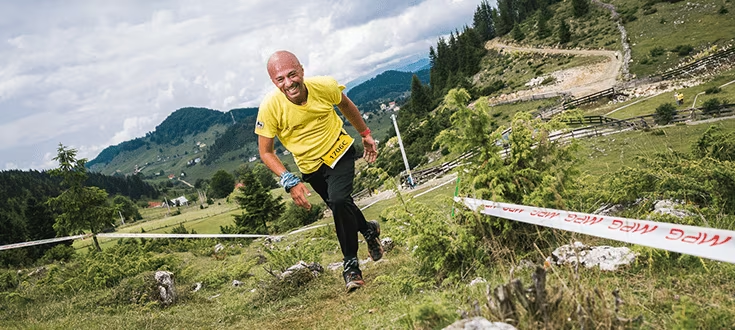
“I’ve circled the Earth about twice since I started running”
Andrei runs between 5,000 and 7,000 km every year: “So, basically, I’ve circled the Earth about twice.”. In official competitions, he has run 10,000 km and doesn’t want to stop there.
“Big numbers usually scare us. At conferences, when I ask people, ‘Would you be able to run 1,000 km in the next year?’, no one raises their hand, except for those who run regularly. 1,000 km is intimidating. But if you divide 1,000 km by 365 days, it means 2.7 km a day. It’s not that scary.”.
Andrei, an endurance athlete, began a project in 2018 that is set to span 7 years. Over these 7 years, he has set a goal to run 40,000 km, or 5 million steps. He is on track and even hopes to finish a little ahead of schedule: “The idea is to break down a very large goal into days or hours. To divide it into very small, feasible objectives.”.
“I want to run every single day until I’m 100.”
And if a 7-year project seems like enough of a life goal for an athlete, Andrei didn’t think so: “At the beginning of the year, half-jokingly, I said, ‘I’m almost 50, I’m 47 now. I’ll probably live to be 100, so that’s about 20,000 days left.’ So, I set a goal to run every day for 20,000 days. I’m currently on day 96 (#96/20000). Running at least until I’m 100 is a good goal. We’ll see what happens after that.”.
The birth of the Filgud brand
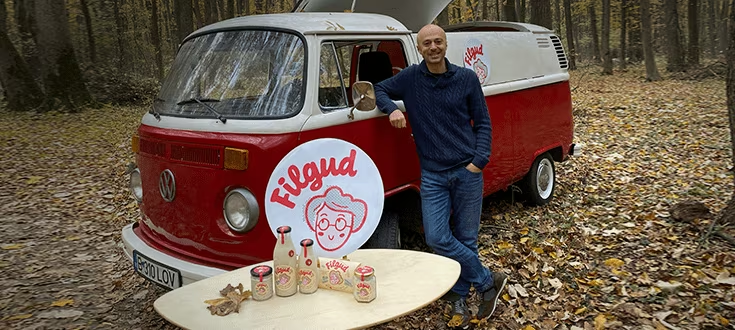
Filgud – a successful vegan business
After deciding to go vegan, Andrei wanted to find as many meal options as he could enjoy, so he took a vegan cooking course organized by Rodia, the restaurant where he had a lunch subscription. After the course, he showcased his new skills to his family. He tested some recipes with family and friends, who were very impressed, though they initially didn't believe everything on the table was made entirely from plants. When his loved ones told him it would be amazing if they could find such products in stores, Andrei says a lightbulb went off.
“I said, let’s launch this business. I partnered with the friend who owns the restaurant, and in 2019 we launched Filgud. That was the beginning. Everyone who knew me said this was the business that suited me best. And for me, it was very comforting because I knew I was putting food on my family’s table and my own that I knew from the source. From the raw materials to what ends up on the shelf. We consume these products every day, so it’s natural that I want to produce them. For me, they are functional foods. They offer nutrients, not just calories,” Andrei said.
Filgud cashew spread with sun-dried tomatoes and arugula – on the shelves of major supermarkets
When he started his entrepreneurial journey with his business partner, Fadia, Andrei wanted to reach a point within 3 years where they would be “shipping by the truckload.”. “I remember at the beginning, we made 16 jars. I printed a picture of a white semi-truck with the Filgud logo on it on a piece of paper. That was the goal. For our products to reach as many people as possible, we needed two things: funding to increase production capacity and the reach to get into as many locations as possible.”
Andrei and Fadia wanted to focus solely on production, creating the same vegan products that were on their own families' tables every day. That’s why they outsourced all sales and distribution and focused exclusively on getting Filgud onto supermarket shelves. “We initially started discussions with Kaufland and Mega Image, where we felt our audience was. They were very receptive, and we began our collaboration with them right during the pandemic, when people had become more open to these types of foods.”
“We want to take the business to the level of publicly traded and international companies. I believe we have very good, price-competitive products that we can take abroad. In the first phase, we need to consolidate and cover the growing demand in Romania. There are simple steps to get there, but you need patience. It takes time and the ability to overcome every obstacle.”, Andrei told us.

Financial challenges and solutions
On business challenges and factoring, the "fantastic" solution for business growth
Since its inception, the main challenge for Filgud has been production, not sales. This is because demand has always exceeded what Andrei and Fadia could produce.
“That was a challenge: finding production capacity and getting machinery that fit our business model. All our spreads are made with fresh vegetables. The parsley, green onions, red onions, and other vegetables are all fresh. We don’t use dried vegetables or flavorings. That’s why not just any industrial equipment works; you can’t just pick any filling and mixing line. You need something customized. The process took about 12 months, and we managed to get the equipment we needed to help us scale the business.”, Andrei explained.
“Instant Factoring came along at the best possible time for us. In Romania, and elsewhere, startups aren’t financially supported by the state or banks. No startup has significant volume or extraordinary profitability from the start. At the beginning, you use your own money or funds from private investors, and you’re focused on volume. You have high initial costs and not the kind of sensational profitability that makes you attractive to banks. So, it was clear we needed a financing solution.”, Andrei shared.
Factoring acted as a lifeline when long payment terms prevented Andrei from producing as much as he wanted with Filgud—or at least as much as the market demanded.
“There is this gap between payment and collection terms. We collect from supermarkets and our partners in about 30-45 days, but many of the payments we have to make are upfront, because very few suppliers offer credit. So you’re stuck in that cycle: you wait to collect money, then you restock and produce again. You can’t leave supermarket shelves empty; you clearly need to have stock at all times. As a business, you’ve produced and sold, but next week another order comes in, and that’s when you need to take your supermarket invoices to the factoring institution. You get your money immediately, and with that money, you buy raw materials and produce for the following week. The equation is very simple.”, Andrei Roșu explained.
“For us, factoring is fantastic. It’s as if we’re paying and collecting at the same time. We can grow indefinitely this way.”-Andrei Roșu
Regarding his experience with Instant Factoring, Andrei says it has definitely been positive.
“I’m surprised that more startups don’t use this solution. Yes, there is a factoring fee, but the alternative would be to use your own money or your shareholders' money—money that is very expensive. To get financing for equipment, we sold a part of the company to private investors, and with that money, we took the firm to the next level. You can follow that business model, selling off parts, but eventually, you’ll have nothing left. So it shouldn’t be viewed that way. Yes, you have to pay a commission of x% on those invoices. But what’s the alternative? Giving away x% of your company. You might regret that in 3-5 years.”
Lessons on courage
“A ship in harbor is safe, but that is not what ships are built for.”

And since we talked about marathons and ultramarathons, the joy and challenges of being a parent, business obstacles, and how to overcome them, it seemed only natural to arrive at the topic of fear. Because there is a dose of fear in everything. But to succeed, you must find the right mechanisms to overcome it.
“Like anyone else, I have many fears and phobias. Generally, most fears are irrational—they don’t materialize in a realistic way. And I realized that, sure, the comfort zone is very pleasant. It’s that space where everything is safe, you have things under control, everything is predictable, and you know what to expect. But that’s not a place where you grow. A ship in harbor is safe, but that is not what ships are built for. That’s why people climb Everest, go to the Moon, go to Mars. There is something in us that needs to explore what is happening around us, but also within us. Because the moment you conquer your fear, you automatically break through barriers,” , Andrei told us.
Then you can become more, be more, and have more. You discover that you are much stronger than you think. You must create the context where being strong is your first and last option. Have goals that you prepare for thoroughly and that transform you. That is the beautiful part of big goals. Both in business and in your personal life. –Andrei Roșu.
Photo: Andrei Roșu
Turn an issued invoice into cash in 24h.
You focus on your business, we support your cash flow. Collect cash from your issued invoices instantly, without waiting 30, 60, 90, or 120 days until the payment term.
Table of contents