
When companies do not have money set aside, the cash reserve available to cover recurring expenses during tough times, they are vulnerable to external shocks. When businesses preserve cash by extending payment terms with suppliers, interdependence between companies grows, and that amplifies systemic risk.
Recent tax changes, along with highly likely tax increases in the first quarter of next year, will make financing harder to access, and inflationary pressure will raise the cost of financing. The second-round effects could be even more damaging for certain sectors and for businesses hit by falling sales, slower collection of receivables, higher financing costs, and more difficult access to bank or trade credit. As a result, some companies will resort to layoffs, adding to a new wave of weaker consumption and lower business revenues. In the end, the state may suffer the most. The insolvency of vulnerable companies will reduce the taxes and contributions paid to the state, while social assistance and unemployment costs will rise. Lower consumption will also cut VAT revenue. All of this will increase the fiscal deficit, not reduce it, which is what is needed. Since narrowing the fiscal deficit and refinancing public debt are already becoming more difficult, 2025 looks set to be a very tough year.
In this context, with pressure on business liquidity likely to be widespread over the next few years, we believe sharing best practices for strong treasury management can be useful for the business community. Below are a few ideas for entrepreneurs and managers running companies in Romania who want sustainable cash management.
1. Selling is pointless if you do not collect. Profit is pointless if you do not have cash. Both problems can be solved by speeding up invoice collection, and rapid factoring is the simplest and most useful tool for the job.
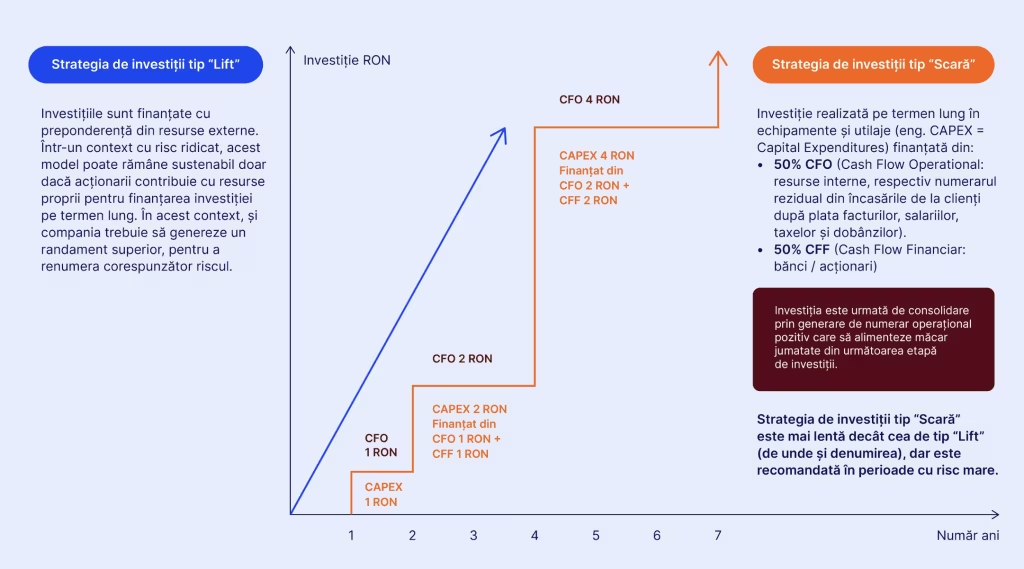
2. Patience. When the ice is thin, move step by step. Financial analysis principles recommend that at least half of long-term investments should be financed through operating cash generated by profits reinvested in the company, while the rest can be covered by loans from credit institutions, long-term bond issues, bringing in a strategic partner, or loans from affiliated entities.
So financing investments too heavily from external sources makes a business more vulnerable to the availability and cost of financing. That is why, for 2025, I recommend a STAIRS growth strategy (Stairs, an investment followed by consolidation through positive operating cash flow that funds at least half of the next investment stage), not a LIFT strategy (Elevator, an investment followed by another round of investment before the previous one starts generating positive operating cash flow). See the chart below. This strategy can only be implemented by collecting invoices very quickly, reinvesting profits, and fueling a new cycle of sales growth.
3. Treat others the way you want to be treated. Extending payment terms with suppliers cannot be a long-term cash strategy, because their tolerance is limited. Any commercial abuse through unjustified non-payment of suppliers seriously damages a company’s credibility and, in the long run, limits business opportunities. What is more, if this behavior becomes widespread across the business environment, as it has in Romania over the past decade, the strategy of generating cash by extending supplier payment terms can backfire on the company promoting it. This happens when companies that delay payments to suppliers collect their own receivables more slowly. What should you do? Collect your customer invoices very quickly with instant factoring services, sell today and have the money in your account tomorrow, so you can pay your suppliers fast and secure the trade discount you need to cover the cost of factoring and grow profitably.
4. Act in the short term, but always think long term. Selling finished goods from inventory cannot be a long-term cash strategy, because inventory levels are limited. On top of that, a company risks losing major commercial orders because stock is unavailable and delivery times are extended, which creates a competitive disadvantage. Of course, when cash is tight, it is easy to buy time by selling from inventory. But use that time wisely to find viable long-term solutions. What should you do? Monitor the competition and know the market’s average inventory turnover period. If your inventory is broader and more diversified, that can be a competitive advantage, but you need to know how to capitalize on it. Your revenue and profits should grow faster than those of competing companies precisely so you can finance the additional inventory. Again, instant factoring services can be an excellent solution for collecting invoices quickly and financing the inventory needed for an aggressive commercial strategy.
5. Balance your customer relationships. Generosity and stinginess both cost money. Collecting receivables very quickly by putting pressure on customers, much faster than average market practice, cannot be a long-term cash strategy. Customers will move to other suppliers, and you will lose business. At the same time, excessively extending collection terms carries enormous risks, especially in the years ahead. That is why you need to get something back for any extension of collection terms, higher sales, a better profit margin, or guarantees that cover the risk of non-payment. This is essential because time costs money, and any extension of customer payment terms creates costs for you, bank loans to finance working capital, factoring, insurance against the risk of non-payment, and human resources dedicated to monitoring customer credit risk.
Of course, other aspects are also essential in cash flow management, but after nearly two decades of experience in credit risk management and dozens of financial analysis books, I believe the practices presented here are the most important.
***
This article was created in partnership with Iancu Guda
Iancu Guda is an economist, author, and host of the show “Banii în Mișcare” on Digi24.
His mission is to help people and entrepreneurs put their money to work intelligently, for investments and financial choices that pay off in the long run.
Turn an issued invoice into cash in 24h.
You focus on your business, we support your cash flow. Collect cash from your issued invoices instantly, without waiting 30, 60, 90, or 120 days until the payment term.
Table of contents