
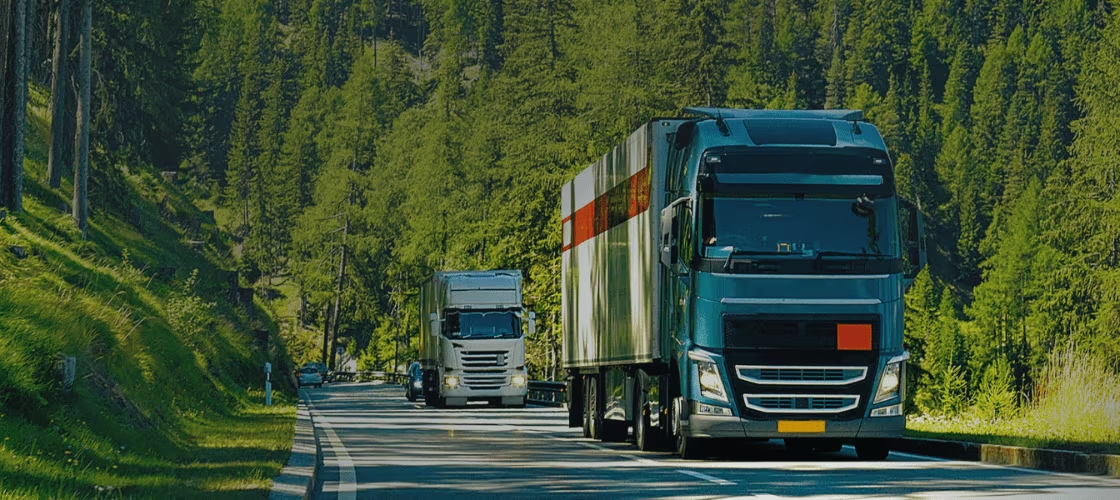
Romania’s transport industry has seen real growth in recent years, but the pandemic and the war in Ukraine have left their mark on SMEs in the sector, and the recent surge in fuel prices is only making things even harder for transport companies.
Road freight transport companies in Romania are now looking for solutions not for business growth, but for survival in a market where that is becoming harder and harder.
The challenges transport companies face are hitting small and medium-sized enterprises hardest, and they say the financing solutions offered by the government and banks are very hard to access.
What does 2022 look like for transport companies?
Unfortunately, not very good. Romania’s road freight transport industry is facing 3 major challenges, and there are too few solutions to change much:
- Rising fuel prices
Fuel prices in Romania have risen sharply this year, and although the trend seems to be leveling off, the situation is still uncertain. With no solution in sight, the transport sector risks grinding to a halt, which would have a major impact on the economy.
In a study conducted by Instant Factoring, the Romanian fintech focused on micro-financing SMEs, the owner of a transport company confirmed that diesel is the biggest problem right now: “You need it to keep the business going.”
And that isn’t the only problem transport companies are facing.
- The international labor shortage
Another blow to the transport sector is the driver shortage, which is severely hampering companies’ operations, both in Romania and across Europe.
Decebal Popescu, founder of Transport Academy, a consulting firm for transport businesses, explains that this crisis is driven first and foremost by declining interest in the profession. In Romania, drivers don’t have well-regulated working conditions, so they prefer to work in Western European countries.
“In Romania, there are around 200,000 drivers for 160,000 trucks on the market, including those owned by large companies. There should be somewhere around 210,000-215,000 drivers working in the country.”
- Very long payment terms
The reason transport companies can’t cope with rising prices is tied to payment terms. “They’re very long, 45, 60, 90 days, especially for domestic transport”, explains Decebal Popescu.
And that’s not all.
Those payment terms don’t always start from the invoice date. After completing a trip, the transport company has to send the original invoice to the customer, which can take a few days. Add the invoice processing time, around 3 weeks, and the final payment term can stretch to as long as 120 days.
“This month I’m collecting money for an invoice from 2 months ago, at a different price per kilometer. Without capital, there’s no way to keep 20 routes running at today’s diesel prices.”, said the owner of another transport company in the Instant Factoring study.
Is there a way out?
During the pandemic, the government implemented financing schemes to help transport companies withstand the challenges brought on by the health crisis, but they proved very hard to access.
Another transport company owner who shared his story in the Instant Factoring study explained that “In Romania, there is no support for small and medium-sized companies.”
When you’re trying to keep your business afloat but get no real support, it’s very hard to move forward and keep operating, let alone actually grow the business.
“I tried getting a startup loan from every bank, I kept talking to them, but nobody helps you with anything. The government and its institutions don’t take on any risk, and they don’t make any kind of benefit available to any citizen. All the risk is on us, the small players.”, the transport company owner said.
Let’s recap
- Transport companies have been dealing with one crisis after another for some time now, without any meaningful support from state institutions.
- Fuel prices are high, and trucks need fuel to keep moving
- The driver shortage risks turning into a full-blown crisis and fundamentally affecting the transport sector
- Some transport companies wait as long as 3 months to collect payment on their invoices from customers
How can a transport company, in this context, think about growth instead of survival?
First stop: Instant Factoring
Instant Factoring offers a financial service that’s different from a loan, but can give transport companies the breathing room they need right now.
In short: a transport company no longer waits 90 or 120 days to collect payment on its invoices, it uploads them to its user account on the platform. The invoices are checked within 2 hours, and the money reaches the account within 24 hours.
Then everything gets simpler: the transport company can fill up for a new trip, pay its vehicle installments, pay drivers’ salaries on time, and finally think about growth.
What transport companies that already use Instant Factoring say:
- “I used the money for fuel, and later I bought a tractor unit and a trailer. I made investments. They seem very prompt to me. From the moment I sent them the invoices, I knew that within a few hours they had already sent them to the customer for confirmation. Everything feels very straightforward.”
- “I paid absolutely everything, including the bank, installments, leasing, and whatever else I still had to pay. But the drivers were the first people I paid with the money I got from Instant Factoring.”
- “They really offer top-notch service.”
- “During the pandemic, I applied to Instant Factoring and made a lot of investments. It worked better for me to get the money faster instead of waiting so long for payments from customers. That’s how it helped me grow the company.
Turn an issued invoice into cash in 24h.
You focus on your business, we support your cash flow. Collect cash from your issued invoices instantly, without waiting 30, 60, 90, or 120 days until the payment term.
Table of contents

.png)
.png)