
Managing cash flow is a critical part of running a business, whether you're dealing with normal or exceptional times. Among an entrepreneur's daily tasks, your cash situation can't be overlooked, especially when it becomes critical.
Given the effects of the current crisis, you need to understand:
- what cash flow is;
- why it matters in business and in the economy;
- how to maintain a healthy level of cash.
Even in difficult times, there are certain things you need to keep in mind to protect your business. One of the most important is your company's cash flow.
What is cash flow?
In short, cash flow refers to the cash coming in and going out of your business.
Think of cash flow as a symptom in the body. If it's positive, your company is financially healthy and all operations are running normally. You have control over expenses, sales are going well, and you have enough funds to keep your business running smoothly.
A negative cash flow level is a warning sign that things aren't working properly. This is where your attention and involvement are needed. A negative figure shows that:
- your expenses are higher than what you collect
- you don't have enough cash to maintain your operations and pay your debts.
In a period of economic uncertainty, it's especially important to maintain positive cash flow. Companies of every size risk insolvency because they don't have access to the cash they need to survive the crisis. The main reason is that many Romanian entrepreneurs don't pay enough attention to cash flow and don't take concrete steps to improve it.
What is cash flow used for?
Cash flow has many uses, both in running a business and in financial and accounting analysis. You can use cash flow to calculate:
- Net present value, the present value of cash inflows minus the present value of cash outflows over a specific period.
- Internal rate of return, the return an investor earns after making an investment;
- Liquidity, a company's ability to meet its financial obligations;
- Cash flow yield, how much money a business generates per share relative to the share price, expressed as a percentage;
- Cash flow per share (CFPS), cash from operating activities divided by the number of shares outstanding;
- Cash conversion cycle, the time between when a company pays for its inventory (the cost of goods sold) and when it collects payment from its customers;
- Dividend payments, cash flow can be used to fund dividend payments to investors;
- Capital expenditures, cash flow can also be used to fund reinvestment and growth in the business.
Why does cash flow matter in the economy?
Over time, decision-makers within a company have considered that several factors can contribute to a country's economic development. As a result, economic goals can be affected by:
- macroeconomic conditions;
- other variables, such as prices, employment levels, and more.
More recently, microeconomic behavior has also been taken into account. For a more complex analysis, it became necessary to include variables that define the development and activity of companies, and cash flow is one of them.
What are the types of cash flow?
There are several types of cash flow. That is why it's important to understand exactly what each one involves. These include:
- Cash from operating activities, this refers to the cash generated by a company's core activities. It does not include cash flow (CF) from investments. You can find it in the company's cash flow statement.
- Free cash flow to equity (FCFE), the cash available after reinvesting back into the business (capital expenditures).
- Free cash flow to the firm (FCFF), a measure that assumes a company has no leverage, or debt. This CF is used in financial modeling and valuation.
- Net change in cash, the change in the value of cash flow from one accounting period to the next. You can find it at the bottom of the cash flow statement.
Which businesses are affected by cash flow levels?
In sectors where costs are high and margins are low, such as manufacturing, food service, and construction, cash flow problems are more common.
Without the ability to move their operations online, companies whose business depends on interacting with people, bars, restaurants, movie theaters, gyms, and others, were especially affected.
The disruption of some economic relationships as a result of social distancing restrictions led to poor cash flow and caused:
- Delayed payments;
- Seasonal demand;
- Fluctuating material costs;
- Poor tax planning;
- Excess inventory.
Tips for managing cash flow
There are a few ways to manage your cash flow better and avoid critical situations:
- Control inventory, too much stock means cash tied up. If you estimate demand and supply well, you'll have a better view of inventory and cash flow.
- Collect receivables, set up a collection schedule using a report where you've recorded the date of each receivable. Track the overdue ones.
- End unprofitable relationships, make decisions about customers who never manage to pay on time.
What does positive cash flow mean?
Positive cash flow means that the net balance in a business's cash flow statement over a given period is greater than zero. Positive cash flow is vital when you're running a successful business.
Even though profit is the final goal at the end of the financial year, daily access to cash is actually the most important thing you need to keep in mind.
Positive cash flow means you're in a comfortable position, with the certainty that:
- you'll pay your employees and suppliers;
- you'll be able to cover your operating expenses.
The higher the positive level, the better. You can invest, hire new people, take on extra orders, and win new customers.
What causes negative cash flow?
Negative cash flow does not necessarily mean that a company's financial performance has been weak. There are many reasons why a business might report a profit but still have very little cash available.
When assessing a company's financial performance, it's important to look at long-term trends and a range of financial statements.
However, the main reason for negative cash flow is delays in collecting from customers. You've already provided the services or delivered the goods, but you still need to wait another 30 or 60 days before you collect your money. In the meantime, your money stays tied up and your cash flow turns negative.
There may be other causes as well: high debt, unplanned or above-budget expenses, lack of control over the financial situation, and more.
What's more, negative cash flow can limit investment and put pressure on your business.
How can you improve cash flow?
The simplest and fastest option is factoring. Factoring gives you the option to finance unpaid invoices from your customers that are still within the payment term. You'll get your money faster. You'll avoid having cash tied up for a few weeks until the due date and get instant access to cash.
The process on www.instantfactoring.com is very simple and fast. You create an account in a few minutes and complete the financing request. The next day, the money is already in your account. The fee is calculated based on 3 factors:
- the number of days left until the due date;
- the value of the invoice you're selling.
You'll have a transparent fixed fee that you'll know from the start.
How does factoring help you maintain a positive cash flow?
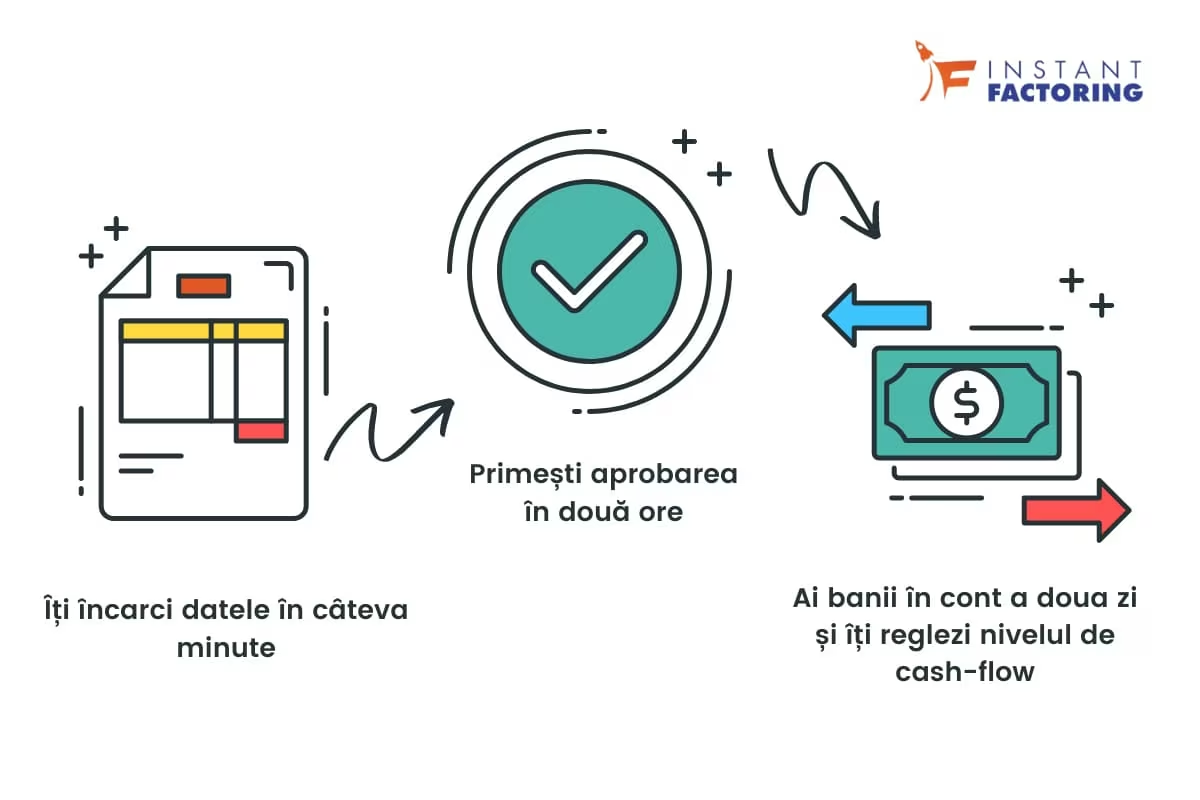
You get the money quickly, without unnecessary red tape or endless waiting. You can use the money you collect to balance your company's cash flow and get back on track.
Since the invoices you finance are for services already provided or products already delivered, factoring is not a debt or a loan. It lets you receive your own money faster.
What are the advantages and disadvantages of factoring?
Among the advantages of this way to improve cash flow are:
- immediate access to cash;
- the flexibility to change payment terms agreed with large and very large customers;
- assessing the creditworthiness of business customers;
- protection against other bad debts;
- flexible contracts;
- it works as a short-term solution;
- it uses invoices as collateral.
The drawbacks of factoring are:
- the higher cost compared to a line of credit;
- it only solves one financial problem, cash flow.
Conclusions
Besides profitability, companies need to ensure enough cash flow to survive.
The level of this flow of money can be influenced by macroeconomic and microeconomic factors. In addition, company cash flows can generate positive or negative effects on the wider economy.
Turn an issued invoice into cash in 24h.
You focus on your business, we support your cash flow. Collect cash from your issued invoices instantly, without waiting 30, 60, 90, or 120 days until the payment term.
Table of contents