

When money gets more expensive, it has to move faster and create more value. Otherwise, the opportunity cost becomes enormous and companies grow slowly. That is exactly the context we are in today, with high inflation making money more expensive by pushing up interest rates. The goal is to slow demand by reducing lending and easing inflationary pressure. Not surprisingly, interest rates on new loans taken out by companies and consumers have hit their highest level of the past decade in recent years, discouraging investment, consumption, and business growth.
To avoid this spiral, companies need to offset more expensive money, weaker consumer spending, and tighter lending by accelerating working capital turnover. In competitive businesses, money moves fast and creates high added value. In practice, capital is drawn from credit institutions, suppliers, reinvested profit, or external capital injected by investors, then invested in assets that generate profitable sales, which are then collected quickly. The point of running a business is to generate more cash at the end of the cash conversion cycle than at the beginning, by creating added value through a product or service that the market wants. The following diagram summarizes the stages of the cash conversion cycle:
- purchasing from suppliers
- storing raw materials, work in progress, or finished goods
- sales and collection.
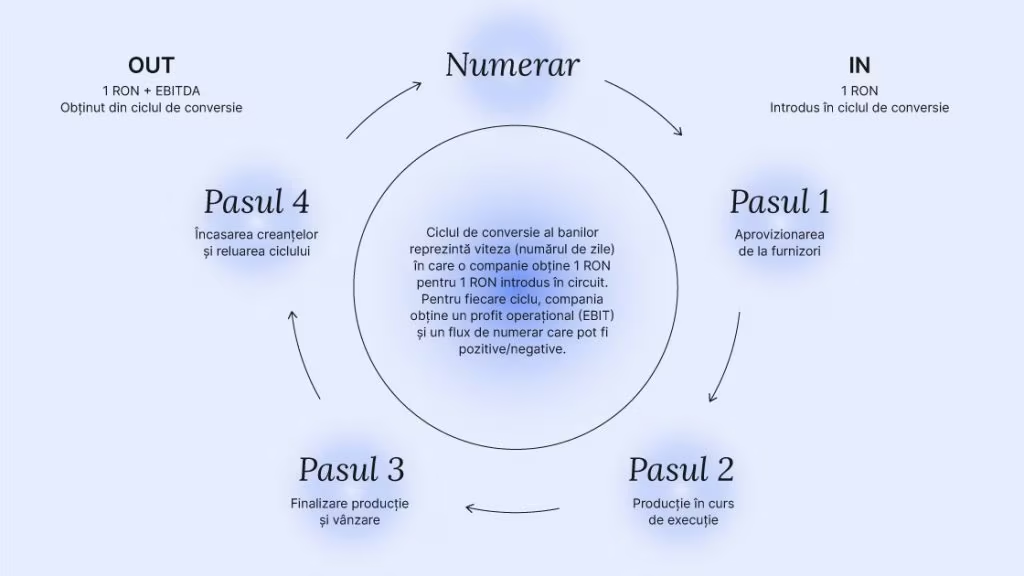
In practice, the cash conversion cycle reflects the speed, measured in days, at which any company turns 0.20 € invested in the business into 0.20 € plus its operating profit margin once invoices are collected and the cycle closes. Clearly, the goal is to maximize both speed and margin. In other words, every company wants to complete as many purchasing, storage, sales, and collection cycles as possible over the course of a year, while achieving the best possible profit. In essence, competitive businesses achieve a better speed-margin mix than their competitors.
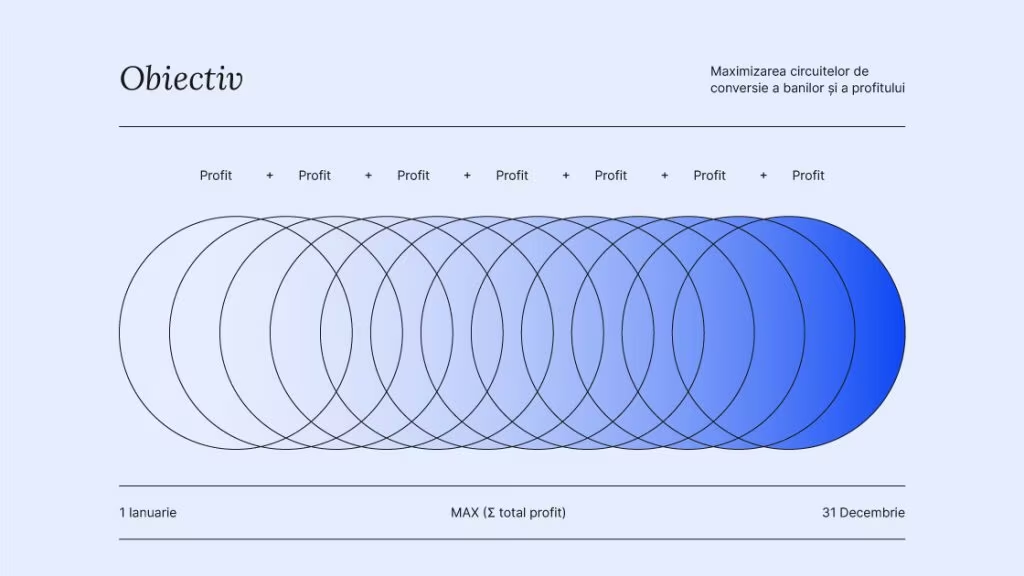
Here are a few best practices to speed up money movement in your business
1. Optimize working capital turnover, in other words, collect invoices as quickly as possible and keep inventory at the right level, while avoiding both oversized speculative stock and inventory that is too low. If you want to collect receivables faster without putting pressure on customers or offering major discounts, which average between 2% and 4% for each month of earlier collection, you can choose fast factoring solutions. In practice, you collect invoices much faster and cover the financing cost through the commercial turnover generated by money returning to your business sooner. This helps you move money faster through your business, increase turnover, and grow revenue and profit.
2. Every entrepreneur needs to understand that the cash conversion cycle should move toward balance. When it is perfectly synchronized, the average supplier payment term should match the combined duration of inventory turnover and receivables collection. Again, factoring solutions help you manage receivables collection so you can balance the conversion cycle.
3. If the operating cycle is out of balance and has a positive value, meaning the combined duration of inventory turnover and receivables collection exceeds the average supplier payment term, the company must:
- finance its deficit, namely its working capital need, which is the difference between inventory and receivables balances, minus supplier balances, in a sustainable way. The safest option is to reinvest profits in the company. Of course, this means postponing dividend payments to shareholders. If you want to avoid these situations, you can speed up receivables collection to reduce the positive values in the conversion cycle.
- make sure raw material or goods inventory is not too high, and that there are no difficulties in selling finished products or goods;
- make sure it has an efficient receivables collection system. It is recommended to review the customer portfolio regularly by carrying out a financial analysis of existing customers and checking public information about their payment behavior (CIP, outstanding tax liabilities to the state, commercial court cases, negative information about the deteriorating financial position of companies in the same group, etc.). The intensity of customer risk assessment and monitoring measures should match the size of the exposure, meaning the outstanding balance, and the level of credit risk identified for that customer.
4. If the cash conversion cycle is out of balance and has a negative value, then the company should:
- use that surplus as efficiently as possible, through long-term investments that generate additional profits that are reinvested in the company;
- communicate as transparently as possible with suppliers to secure longer payment terms that are mutually agreed. All these conditions are necessary, but not sufficient, for a competitive business.
All these conditions are necessary, but not sufficient, for a competitive business. In the next article, we will see how competitive companies manage the speed x margin pair efficiently.
***
This article was created in partnership with Iancu Guda
Iancu Guda is an economist, author, and host of the show "Banii în Mișcare" on Digi24.
His mission is to help people and entrepreneurs put money in motion intelligently, for investments and financial choices that do good in the long term.
Turn an issued invoice into cash in 24h.
You focus on your business, we support your cash flow. Collect cash from your issued invoices instantly, without waiting 30, 60, 90, or 120 days until the payment term.
Table of contents