

We often hear the term "competitiveness" in business, and you can measure it through several indicators: growth in turnover or profit, inventory breadth, wage trends or labor productivity, the return on capital invested by shareholders, a strong cash profit margin, brand strength, agility in responding to market changes, and more. In general, a high-performing business can maintain its competitive edge despite economic challenges, copycat attempts, or the emergence of substitute products. We're convinced this is a topic of real interest to every entrepreneur with a long-term vision. Next, we'll look at the real essence of business competitiveness, the speed-margin pair.
What do speed and margin mean in business?
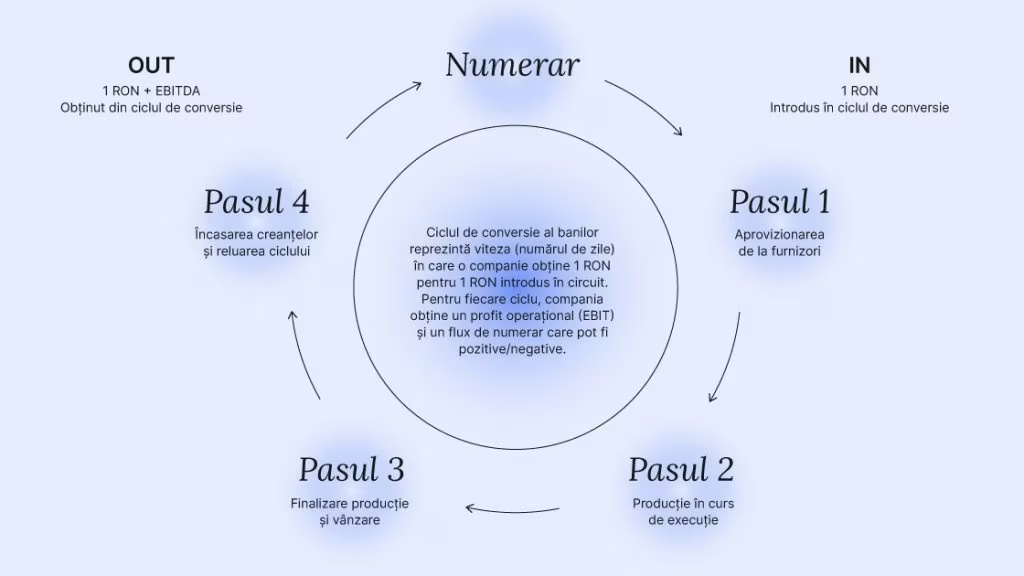
When we talk about "speed" in business, we mean how long it takes a business to turn 0.20 € invested in the supply, storage, sales, and collection cycle back into cash. In practice, this is the turnover speed of working capital, calculated by dividing working capital (current assets - short-term liabilities) by turnover, then expressing the result in days by multiplying it by 365. The formula becomes:
Working capital turnover speed = (Current assets - Short-term liabilities) / Turnover x 365
When it comes to profit margin, there are several useful benchmarks here (markup, gross margin, operating margin, net margin), but the most important benchmark for a business's value remains EBITDA, an acronym for the English term Earnings Before Interest, Tax, Depreciation and Amortization, calculated by adding operating profit (EBIT) and amortization. In practice, a higher EBITDA level than competing companies reflects a competitive business model and a valuable business. That's why you can capture the essence of a business's competitiveness through the speed-margin pair, in other words, how quickly capital moves through a business and how much added value it generates at the end of the cycle. The image below illustrates the speed & margin pair and gives concrete examples for several activities based on companies' 2022 financial statements.
In Romania, the average conversion cycle is 50 days, with a 12% EBITDA margin. This means that, on average, any receivable worth 2,000 € left uncollected for 50 days does not just create an equivalent risk of non-collection. An even bigger cost is the lost opportunity, namely putting that 2,000 € back into a new supply, storage, sales, and collection cycle that lasts 50 days and can generate 2,100 € at the end of the cycle, based on the average EBITDA margin of 12% across the market.
Of course, each sector has its own speeds and margins. For example, in auto parts retail, the retail segment turns working capital in 25 days and operates at a 6.2% margin. In construction materials distribution, the cycle is slower, 32 days, but the margin is higher, 9.8%, while auto repair services, which combine diagnostics and repair work with selling auto parts as an intermediary, post the highest margin at 19%.
A very effective way to optimize the speed x margin pair is factoring. It accelerates receivables collection and generates fast cash that you can put back into operations to generate new profitable turnover. This gives you additional financial resources, enough to cover the cost of factoring financing and still free up money for investment and business growth.
How can you boost business competitiveness?
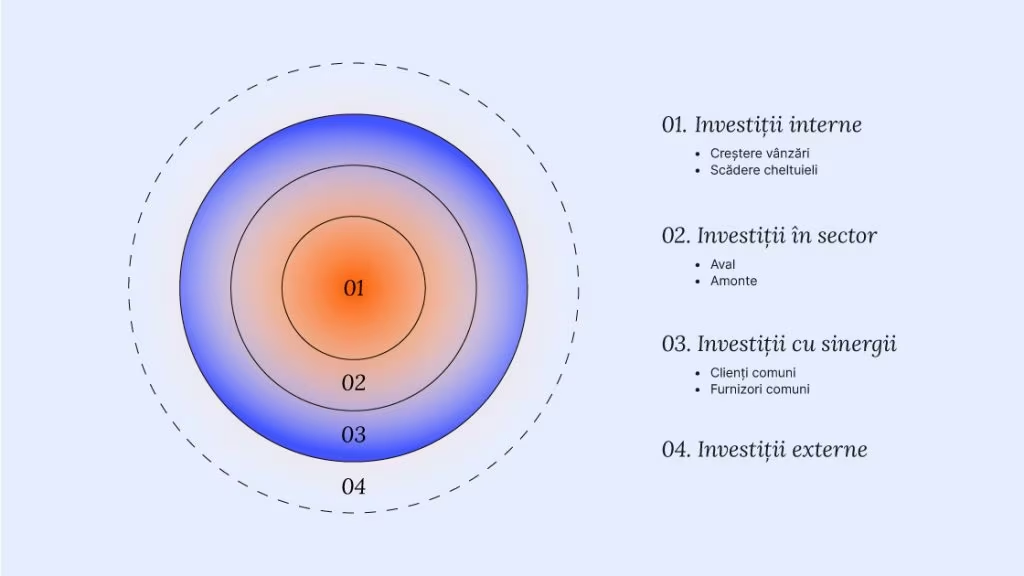
Clearly, a business can stay competitive over the long term only through efficient investment. Still, money is limited and it costs you, both in interest and in missed or underused opportunities. That's why you need to prioritize investments and plan them strategically around the following priorities, as the image below shows:
1. Projects that grow revenue or reduce costs by investing in the core business to optimize operations, logistics, or sales.
2. Investment projects in products and services that are synergistic with or complementary to your core offer, focused on customer needs or supplier integration and diversification. These can be additional complementary services for customers, helping you build loyalty and strengthen commercial relationships.
3. Investments in the partial or full acquisition of companies that already offer products or services that are synergistic with your core business (the areas targeted in point 2). Where human or technological resources are limited, inorganic growth through acquisitions can speed up the execution of your growth strategy.
4. External investments in other sectors, to diversify your businesses and expand your entrepreneurial portfolio. Still, contagion risk can be significant if something fails, because a core business that performs well can be affected by a new business that is not profitable. To reduce contagion risk, we always recommend the following best practices:
- separate financing for each company (no significant intragroup debt);
- a dedicated team for each business;
- businesses that perform differently across the stages of the economic cycle (in other words, avoid positive correlations).
You can create these kinds of correlations by adding services or products that behave differently when customers' purchasing power falls. For example, a car dealer can also open a service operation. When the economy moves into recession, new car sales drop, but existing vehicles are repaired more often. A car wash can also provide relatively stable cash flow because it serves an ongoing need throughout the economic cycle.
If you missed the article on how to put money to work in your business, read this article about working capital turnover and how fast factoring can help you.
***
This article was created in partnership with Iancu Guda
Iancu Guda is an economist, author, and host of the show "Banii în Mișcare" on Digi24.
His mission is to help people and entrepreneurs put their money to work intelligently, through investments and financial choices that make sense over the long term.
Turn an issued invoice into cash in 24h.
You focus on your business, we support your cash flow. Collect cash from your issued invoices instantly, without waiting 30, 60, 90, or 120 days until the payment term.
Table of contents
.png)